2026-2-28 C4 Program Notes
Program Notes by Susan Swinburne
Gabriela Lena Frank – Elegía Andina for Orchestra
Composer Gabriela Lena Frank is a musical phenomenon of epic proportion, possibly the most multi-hyphenated contemporary artist at work in classical music today. She is a pianist-composer-musical anthropologist and a creative mentor to the emerging composers whom she hosts at her Boonville farm – where she is also a farmer-beekeeper-environmentalist – to attend a residency at the eponymous music academy she founded in 2017 to encourage young talent. She is of Peruvian-Chinese-Spanish-Lithuanian-Jewish ethnic heritage, and actively explores these cultural connections in her composing. Hearing-impaired since birth, she lives with Graves disease, an auto-immune condition. Frank is the winner of innumerable prestigious awards-honors-kudos, including a Guggenheim fellowship, the 25th Anniversary Heinz Award, and a Latin Grammy. The Washington Post included her in their recent list of the 35 most significant women composers in history.
Frank’s interest in incorporating her multi-cultural heritage in her composing arose during trips she took as a young woman with her mother to visit Peru, reconnecting with extended family and searching out indigenous musical traditions:
“I realized that I had found my mission,” Frank explained. “I wanted to, in a very general way, be as mestiza in my music as I was in my person: I’m multiracial, I’m multicultural, and I think that that’s something deeply American. I love my country, and I’m surrounded by daughters and sons of immigrants that contribute and work hard — that was uppermost in my mind then, and in the course of recent events in our country, it’s uppermost in my mind now. It’s something that has become more urgent in my work as a musician, not less so.”
Elegía Andina, written in 2000 while Frank was completing her doctorate degree, is the composer’s very first orchestral work. Dedicated to her older brother, the neurobiologist Marcos Gabriel Frank, it takes inspiration from her deep connection to her Peruvian heritage. Of her connection to the family’s South American roots, she says:
“Elegía Andina (Andean Elegy) is one of my first written-down compositions to explore what it means to be of several ethnic persuasions, of several minds. It uses stylistic elements of Peruvian arca/ira zampoña panpipes (double-row panpipes, each row with its own tuning) to paint an elegiac picture of my questions. The flute part was particularly conceived with this in mind…I can think of none better to dedicate this work to than to “Babo,” my big brother — for whom Perú still waits.”
Joaquin Rodrigo – Concierto de Aranjuez
Imagine composing music in Braille. This is the painstaking process by which Joaquin Rodrigo produced every composition he wrote in his very long life (1901-1999). Born the youngest of 10 children to a well-heeled Spanish family, Rodrigo contracted diphtheria at the age of 3, which destroyed his eyes. At age 4, his parents enrolled him in a school for the blind in Valencia where he showed a talent for music, swiftly excelled in solfège, and became an accomplished pianist. Later studies at the Valencia Conservatory added composition to his musical talents. As a young man he moved to Paris and joined a brilliant expat cadre of Spanish artists that included Manuel Ponce and Manuel de Falla (who became a champion of the younger musician). There, he also met Turkish pianist Victoria Kamhi, who in 1933 became his wife and devoted partner in life and music.
So, how did a blind pianist – not a guitarist – come to compose the magnificent work that today is universally acknowledged as the quintessential concerto for classical guitar and orchestra? According to the composer himself, it happened as a result of a well-lubricated dinner party: In September of 1938, I was in San Sebastián on my return to France…It was during a dinner organized by the Marqués de Bolarque with [guitar virtuoso] Regino Sáinz de la Maza and myself.
We ate well and the wine was not bad at all; it was the right moment for audacious fantasizing… All of a sudden, Regino, in that tone between unpredictable and determined which was so characteristic of him, said: -Listen, you have to come back with a ‘Concerto for guitar and orchestra’ – and to go straight to my heart, he added in a pathetic voice: – It’s the dream of my life – and, resorting to a bit of flattery, he continued: – This is your calling, as if you were ‘the chosen one.’ I quickly swallowed two glasses of the best Rioja and exclaimed in a most convincing tone: – All right, it’s a deal!
By the time the Rodrigos returned to Madrid in September 1939, the original Braille manuscript of Concierto de Aranjuez was written and ready to be transcribed into musical score notation. It received its premiere on November 9, 1940 with the Barcelona Philharmonic and Regino Sáinz as soloist.
Aranjuez, just outside of Madrid, is famed for the palace and especially the extensive gardens that surround this centuries-old summer estate of the Royal House of Bourbon. As newlyweds, Victoria and Joaquín Rodrigo rented a small apartment nearby and frequently walked together in the vicinity.
Rodrigo described the Concierto as capturing, “the fragrance of magnolias, the singing of birds, and the gushing of fountains” in the gardens of Aranjuez.
Fun fact: In 1999, on the occasions of Joaquin Rodrigo’s death at age 97, only one piece of Spanish
music outranked Concierto de Aranjuez in paid music royalties: The Macarena, by the Spanish
flamenco-pop duo Los del Rio.
Handel – Water Music Suites 1 & 2
“At about eight in the evening, the King retired to his barge. Next to the King’s barge was that of the musicians, about 50 in number, who played on all kinds of instruments, to wit trumpets, horns, hautboys (oboes), bassoon, German flutes (transverse flutes), French flutes (recorders), violins, and basses; but there were no singers. The music had been composed specially by the famous Handel, a native of Halle, and His Majesty’s principal court composer… the number of barges and above all of boats filled with people wanting to listen was beyond counting.”
So wrote Friedrich Bonet, a Prussian diplomat in London, to his Berlin colleagues in a report detailing the extravagant and wildly popular summer river barge party for which George Friderich Handel composed his delightful Water Music. Written at the behest of England’s King George I, the work famously was performed by an orchestra floating through London on a barge on the river Thames. The date was July 17, 1717. In his own royal barge, the king and his lords, ladies, and retainers, along with hundreds if not thousands of Londoners in their own boats, all rode with the tide from Whitehall to Chelsea. The king’s group stopped for supper ashore, then made their watery way back to Whitehall. The summer excursion began at 8:00 p.m. and concluded at 4:30 a.m. the next morning. His majesty so enjoyed his countryman’s gorgeous new work, as reported by Herr Bonet, he required it to be performed in full, three times.
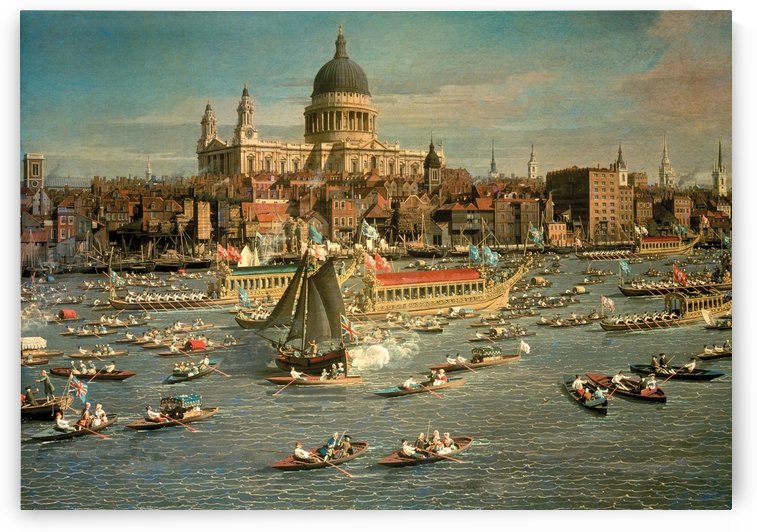
Handel, then aged 32, was already a popular and successful composer in London, his adopted home since 1712. Born in 1685 (incidentally, the same year as both J.S. Bach and Domenico Scarlatti), and raised outside of Leipzig, Germany, Handel was a musically precocious child; but his practically-minded father discouraged his interest in music as unpromising for career purposes. Fortunately, his mother disagreed, clandestinely helping him study piano and later composition. His elderly father died when he was 11, removing that impediment. His studies, experience, and reputation grew in Germany and a European musical career flourished at home as well as in Italy. In 1710, he was appointed Kapellmeister by the elector (aka prince) of Hanover, known then as Georg Ludwig but in 1714 – through truly byzantine hereditary and political machinations – to become George Louis: King George I of England.
It has been widely speculated that the Water Music was commissioned by the king, at least in part, as a P.R. stunt. George I holds the dubious distinction of being arguably England’s most unpopular monarch. The people of England can hardly be blamed for resenting that a distant descendant, German and three generations removed from queen Elizabeth I’s successor James Stuart (reign 1603-1625), ascended to their throne primarily because he was the next protestant in line, leaping over 48 others who were Catholic. Handel, however, was tremendously popular and everybody loves a party, so the King charged Handel with composing this masterpiece of entertainment to accompany his splendiferous spectacle of a river party. From the river barge, the music was free for all – anyone on the riverbanks as well as anyone with a boat on the water – to hear and enjoy.
Fun fact: Water Music is the first orchestral work in England to include brass instruments as full-fledged members of the orchestra, no longer relegated only to “conjuring images of the hunt” (Martin Pearlman, Boston Baroque).