Please Take the Survey and Help us Shape your Concert Experience!
We thank you for attending and hope you enjoyed this Long Beach Symphony concert. Your feedback will help us create even more memorable experiences.
Please follow the link below. This survey takes approximately 5 minutes to complete.
Gershwin, Copland, James Price Johnson, and SoCal premiere of Visions of Humanity & UnityPROGRAM NOTES for 10/10/26
Star-Spangled Banner – John Stafford Smith
In September, 1814, John Stafford Smith was asked by his brother-in-law, Francis Scott Key, to set to music the poem Key had recently written to celebrate the victory of American patriot forces in defending Baltimore’s Fort McHenry from the Royal Navy. The War of 1812 had pitted the British against the newly independent United States as players in a larger conflict that also involved Canada and France. Defeating this existential threat to the sovereignty of the USA, just 36 years after the success of the American Revolution, was paramount. The battle that inspired Key to compose his stirring poem proved to be a turning point in the war. His patriotic anthem “The Star-Spangled Banner” – inspired by the appearance at dawn, after a fierce overnight battle, of a huge American flag still flying over the fort – turned into a rallying cry for resilience, determination, and pride in defending American independence. The war ended in December 1814, and the Star-Spangled Banner gained popularity with Americans. By 1889, the U.S. Navy had incorporated it into ceremonial flag raisings, and in 1916, President Woodrow Wilson announced it, unofficially, as the “national anthem.” This status was ratified by Congress on March 3, 1931, and signed into law by President Herbert Hoover.
Online Content:
https://en.wikipedia.org/wiki/John_Stafford_Smith
https://www.smithsonianmag.com/history/francis-scott-key-the-reluctant-patriot-180937178/
https://en.wikipedia.org/wiki/The_Star-Spangled_Banner#
Fanfare for the Common Man – Aaron Copland
Eighty-five years ago – still exhausted after deep losses suffered in World War I, “The Great War,” and the Depression – the United States was doing its best to steer clear of involvement in World War II. Tragically, necessity banished reluctance after Japanese Kamikazes devastated the American fleet at Pearl Harbor, Hawaii, on December 7, 1941. Within days, President Franklin D. Roosevelt and the American Congress declared the U.S. at war with Japan, Germany, and Italy.
Throughout the nation, there followed a wave of patriotic fervor that reached into every crevice and corner of American society. In the world of music, the conductor of the Cincinnati Symphony Orchestra launched a project to commission composers to write patriotic fanfares that would be performed at the start of upcoming concerts as “stirring and significant contributions to the war effort.” Eighteen works were written and performed, composed by a Who’s Who roster of mid-20th century musicians including Morton Gould, Howard Hanson, William Grant Still, and Virgil Thomson.
“Fanfare for the Common Man” was Aaron Copland’s contribution. Today, it is the only one of the 18 works that has secured a renowned place in the standard repertoire. Copland considered various names for his work; to honor Democracy, the Four Freedoms, Solemn Ceremony, and more. He later reflected on his final choice as follows: “– it was the common man, after all, who was doing all the dirty work in the war and the army. He deserves a fanfare.”
Online content
https://pearlharbor.org/pearl-harbor-history/
https://en.wikipedia.org/wiki/Fanfares_(Goossens)
Visions of Humanity & Unity: 250th Anniversary of the Declaration of Independence
This newly-commissioned suite of five movements honors and celebrates the ideals of humanism, diversity, acceptance, and freedom enshrined in the U.S. Declaration of Independence on the occasion of its 250th Anniversary in 2026. A consortium of 9 orchestras supported the project to illuminate and champion the seminal principles it expresses, interpreted for cello and orchestra. Each of the five composers commissioned for this project took a particular phrase from the Declaration document as their inspiration and contribution. brought to the project a style enriched by their drastically different cultural backgrounds, and each brings their unique perspective and life experience to their vibrant musical visions of harmony and unity for humanity.
The complete work received its world premiere on August 8, 2026, with Zuill Bailey on cello and the Cincinnati Chamber Orchestra under the direction of Eckart Preu as part of Summermusik in Cincinnati. Tonight’s performance in Long Beach marks the composition’s Southern California premiere.
The movements are explained here in the composers’ own words, listed here in order of presentation:
Chanda Dancy – Intermezzo
As a part of the “Visions Of Humanity” piece, “Intermezzo In Soul” celebrates the beautiful and complicated soul of our great country through the lens of the Black American experience with orchestral colors of Blues, Soul, Jazz and Spirituals in a lyrical and cinematic work that highlights the hope, longing and boundless optimism of the American spirit.
Avner Dorman – Repeated Petitions
I found myself struck less by the famous opening preamble and more by what follows: the exhaustive list of grievances and the concept of “repeated petitions.” I was moved by the image of the colonists arguing, reasoning, and trying again—exhausting every verbal and intellectual resource before finally taking responsibility for their own freedom. […] I wanted to celebrate freedom not as a finished gift, but as something precious, unfinished, and inextricably linked to responsibility. Ultimately, freedom is something we must keep petitioning for: constantly asking who is free, what we are protecting, and what still needs to change.
Zhou Tian – Elegy
“Elegy” offers a moment of remembrance—honoring those whose sacrifices, struggles, and hopes have shaped the nation across generations. The solo cello serves as a solitary voice, singing over luminous string textures in a meditation on resilience, compassion, and the enduring pursuit of unity.
Enrico Chapela – Alebrije
An alebrije is a traditional Mexican folk art figure representing a fantastical creature made by combining characteristics of different real or imaginary animals. Alebrijes are typically painted in vivid colors and intricate patterns. I chose this image as the title of the movement I was commissioned to write for the Visions of Humanity project, since it is part of a work composed by five different composers, each contributing their own culture and musical language.
Mark O’Connor – Fiddler Coming Home
I am known as an American-styled composer and string-player, so I welcome the task here. When I compose my American music, the conceptualizations seem to always include our beautiful habitat and natural world, the human condition and nostalgia for the best parts of our past, the ongoing struggle in racial reconciliation defining the American experience as well as its artforms, our collective hope and optimism for a better future, and always the longing to be more free.
Online Content
https://www.archives.gov/founding-docs/declaration-transcript
James Price Johnson – Harlem Symphony
Harlem Symphony composer James P. Johnson is probably the most important American jazz musician you never heard of. His list of “firsts” is stunning, as is his cadre of close associates: Fats Waller, Duke Ellington, Count Basie, Bessie Smith, Ethel Waters… giants, all. A virtuosic and innovative jazz pianist, he invented the “Harlem Stride
Piano” style and his 1921 recording of the Stride classic “Carolina Shout” holds the distinction of being the first jazz
piano solo on record. As a popular performer in the 1920s, no one eclipsed his talent. Then, in 1923, he composed the Broadway show Runnin’ Wild, and the iconic tune “Charleston” went viral, launching the dance craze that defined the “Roaring 20s.”
Popular success in jazz and on Broadway was not enough for the genius Johnson who also aspired to be a serious composer, striving to meld signature African American musical themes with symphonic art forms. His Harlem Symphony from 1932 takes the listener through four movements depicting views of African American lives in their rich and storied community. “A Subway Journey,” “Song of Harlem,” “Night Club,” and “Baptist Mission” combine to present a full sweep of musical narratives depicting the Harlem he knew, rendered for full orchestra in musical technicolor.
Fun fact: Johnson’s “serious” orchestral manuscripts were lost for 35 years after his death. Maestra Marin Alsop and Johnson biographer Scott E. Brown eventually persuaded Johnson’s daughter to allow them access to boxed Johnson family archives, and – Eureka! – the scores were rediscovered!
Online Content
https://www.jpjohnsonmusic.com/father
https://syncopatedtimes.com/james-p-johnson-forgotten-musical-genius/
https://www.jpjohnsonmusic.com/harlem-symphony
https://www.jpjohnsonmusic.com/biography
https://www.jpjohnsonmusic.com/discovery
George Gershwin – Overture from Strike Up the Band
Closing tonight’s program is the orchestral concert version of George Gershwin’s Overture to his Depression-era Broadway musical Strike Up the Band. Opening on January 14, 1930, just three months after the Black Tuesday stock market panic that launched the Depression, American theatergoers who could still afford attending were hungry for stage fare that poked satiric fun at Big Business while still generating happy endings. The new show’s preposterous and convoluted premise involves machinations by a Wisconsin chocolate baron plotting to orchestrate tariffs on Switzerland over chocolate imports. International conflict ensues, amidst multiple romantic trysts and triangles. Audiences, eager to be carried away for a while, loved it and even as the Depression worsened, it ran for a respectable 191 performances. Gershwin later arranged this concert version of the overture, which good-naturedly brings together the themes of chest-pounding bombast with genuine national pride.
Fun fact: Mickey Rooney and Judy Garland starred in Strike Up the Band for MGM in 1940, but the project has no ties to the Gershwin Broadway show… except for the title song.
Online Content
https://static.qobuz.com/goodies/80/000188608.pdf
https://en.wikipedia.org/wiki/Strike_Up_the_Band_(musical)
https://www.history.com/articles/1929-stock-market-crash
Your 8-20-26 Pirate Voyage Starts Here. What you Need to Know:

- All attendees (including children) require a ticket to enter. Venue Box Office opens at 5:30PM
Getting There:
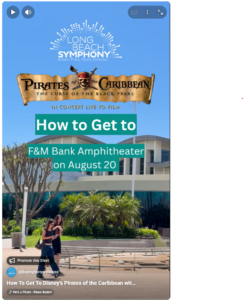
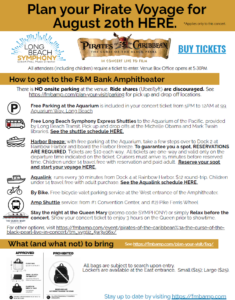
- The pre-concert activities start 6PM. Concert starts at 8PM. Concert is expected to conclude at 10:50PM. If reserving your return on Harbor Breeze, please allow a little walking time to the dock…
- Get ahead of the game! Reserve your night stay at the Queen Mary and use promo code SYMPHONY for your special Friends & Family discount
- There is NO onsite parking at the venue. Ride shares (Uber/Lyft) are not allowed.
- Free Parking at the Aquarium is included in your concert ticket from 5PM to 12AM at 99 Aquarium Way, Long Beach
- Free Long Beach Symphony Express Shuttles to the Aquarium of the Pacific, provided by Long Beach Transit. Pick up and drop offs at the Michelle Obama and Mark Twain libraries. See the shuttle schedule HERE.
- Harbor Breeze: Your full evening of adventure starts with free parking at the Aquarium. Then, take a few steps over to Dock 2 at Rainbow Harbor and board the Harbor Breeze. To guarantee you a spot, RESERVATIONS ARE REQUIRED. Thanks to a partnership with the Symphony, tickets are $10 each way. All tickets are one-way and valid only on the departure time indicated on the ticket. Cruisers must arrive 15 minutes before reserved time. Children under 14 travel free with reservation and paid adult. Reserve your spot and start your voyage HERE.
-
- F&M Amphitheater Shuttle from Long Beach Convention Center or The Pike
- Aqualink runs every 30 minutes from Dock 4 at Rainbow Harbor. $12 round-trip. Children under 14 travel free with adult purchase. See the Aqualink schedule HERE.
- By Bike. Free bicycle valet parking service at the West entrance of the Amphitheater.
- Relax before the concert at the Queen Mary. Show your concert ticket to a wharf attendant and enjoy 3 hours on the Queen prior to showtime.

- For other options, including shuttle services provided by the venue, visit https://fmbamp.com/plan-your-visit/parking/).
What (and what not) to bring:
Stay up to date by visiting the venue website at https://fmbamp.com
Each Guest is permitted one (1) bag. Approved bag types are:
- Clear bag — up to 12″ H x 12″ W x 6″ D
- Small clutch or wristlet — up to 5″ H x 8″ W x 2″ D (does not need to be clear)
- Diaper or medical bag — for the Guest using them
Any bag larger than 5″ H x 8″ W x 2″ D must be clear. Backpacks, outside food and beverage are not permitted. All bags are subject to search upon entry.
Lockers are available at the East entrance. Small ($15); Large ($25)


Guarantee your Seats. Buy Tickets Now!
Learn How Kids 14 and Under Can Get in Free!
Enter to Win:
Program Notes by Susan Swinburne
Gabriela Lena Frank – Elegía Andina for Orchestra
Composer Gabriela Lena Frank is a musical phenomenon of epic proportion, possibly the most multi-hyphenated contemporary artist at work in classical music today. She is a pianist-composer-musical anthropologist and a creative mentor to the emerging composers whom she hosts at her Boonville farm – where she is also a farmer-beekeeper-environmentalist – to attend a residency at the eponymous music academy she founded in 2017 to encourage young talent. She is of Peruvian-Chinese-Spanish-Lithuanian-Jewish ethnic heritage, and actively explores these cultural connections in her composing. Hearing-impaired since birth, she lives with Graves disease, an auto-immune condition. Frank is the winner of innumerable prestigious awards-honors-kudos, including a Guggenheim fellowship, the 25th Anniversary Heinz Award, and a Latin Grammy. The Washington Post included her in their recent list of the 35 most significant women composers in history.
Frank’s interest in incorporating her multi-cultural heritage in her composing arose during trips she took as a young woman with her mother to visit Peru, reconnecting with extended family and searching out indigenous musical traditions:
“I realized that I had found my mission,” Frank explained. “I wanted to, in a very general way, be as mestiza in my music as I was in my person: I’m multiracial, I’m multicultural, and I think that that’s something deeply American. I love my country, and I’m surrounded by daughters and sons of immigrants that contribute and work hard — that was uppermost in my mind then, and in the course of recent events in our country, it’s uppermost in my mind now. It’s something that has become more urgent in my work as a musician, not less so.”
Elegía Andina, written in 2000 while Frank was completing her doctorate degree, is the composer’s very first orchestral work. Dedicated to her older brother, the neurobiologist Marcos Gabriel Frank, it takes inspiration from her deep connection to her Peruvian heritage. Of her connection to the family’s South American roots, she says:
“Elegía Andina (Andean Elegy) is one of my first written-down compositions to explore what it means to be of several ethnic persuasions, of several minds. It uses stylistic elements of Peruvian arca/ira zampoña panpipes (double-row panpipes, each row with its own tuning) to paint an elegiac picture of my questions. The flute part was particularly conceived with this in mind…I can think of none better to dedicate this work to than to “Babo,” my big brother — for whom Perú still waits.”
Joaquin Rodrigo – Concierto de Aranjuez
Imagine composing music in Braille. This is the painstaking process by which Joaquin Rodrigo produced every composition he wrote in his very long life (1901-1999). Born the youngest of 10 children to a well-heeled Spanish family, Rodrigo contracted diphtheria at the age of 3, which destroyed his eyes. At age 4, his parents enrolled him in a school for the blind in Valencia where he showed a talent for music, swiftly excelled in solfège, and became an accomplished pianist. Later studies at the Valencia Conservatory added composition to his musical talents. As a young man he moved to Paris and joined a brilliant expat cadre of Spanish artists that included Manuel Ponce and Manuel de Falla (who became a champion of the younger musician). There, he also met Turkish pianist Victoria Kamhi, who in 1933 became his wife and devoted partner in life and music.
So, how did a blind pianist – not a guitarist – come to compose the magnificent work that today is universally acknowledged as the quintessential concerto for classical guitar and orchestra? According to the composer himself, it happened as a result of a well-lubricated dinner party: In September of 1938, I was in San Sebastián on my return to France…It was during a dinner organized by the Marqués de Bolarque with [guitar virtuoso] Regino Sáinz de la Maza and myself.
We ate well and the wine was not bad at all; it was the right moment for audacious fantasizing… All of a sudden, Regino, in that tone between unpredictable and determined which was so characteristic of him, said: -Listen, you have to come back with a ‘Concerto for guitar and orchestra’ – and to go straight to my heart, he added in a pathetic voice: – It’s the dream of my life – and, resorting to a bit of flattery, he continued: – This is your calling, as if you were ‘the chosen one.’ I quickly swallowed two glasses of the best Rioja and exclaimed in a most convincing tone: – All right, it’s a deal!
By the time the Rodrigos returned to Madrid in September 1939, the original Braille manuscript of Concierto de Aranjuez was written and ready to be transcribed into musical score notation. It received its premiere on November 9, 1940 with the Barcelona Philharmonic and Regino Sáinz as soloist.
Aranjuez, just outside of Madrid, is famed for the palace and especially the extensive gardens that surround this centuries-old summer estate of the Royal House of Bourbon. As newlyweds, Victoria and Joaquín Rodrigo rented a small apartment nearby and frequently walked together in the vicinity.
Rodrigo described the Concierto as capturing, “the fragrance of magnolias, the singing of birds, and the gushing of fountains” in the gardens of Aranjuez.
Fun fact: In 1999, on the occasions of Joaquin Rodrigo’s death at age 97, only one piece of Spanish
music outranked Concierto de Aranjuez in paid music royalties: The Macarena, by the Spanish
flamenco-pop duo Los del Rio.
Handel – Water Music Suites 1 & 2
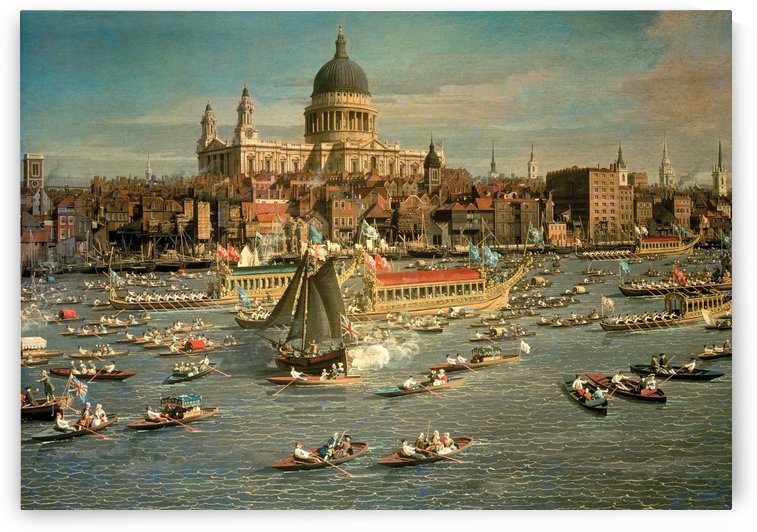
“At about eight in the evening, the King retired to his barge. Next to the King’s barge was that of the musicians, about 50 in number, who played on all kinds of instruments, to wit trumpets, horns, hautboys (oboes), bassoon, German flutes (transverse flutes), French flutes (recorders), violins, and basses; but there were no singers. The music had been composed specially by the famous Handel, a native of Halle, and His Majesty’s principal court composer… the number of barges and above all of boats filled with people wanting to listen was beyond counting.”
So wrote Friedrich Bonet, a Prussian diplomat in London, to his Berlin colleagues in a report detailing the extravagant and wildly popular summer river barge party for which George Friderich Handel composed his delightful Water Music. Written at the behest of England’s King George I, the work famously was performed by an orchestra floating through London on a barge on the river Thames. The date was July 17, 1717. In his own royal barge, the king and his lords, ladies, and retainers, along with hundreds if not thousands of Londoners in their own boats, all rode with the tide from Whitehall to Chelsea. The king’s group stopped for supper ashore, then made their watery way back to Whitehall. The summer excursion began at 8:00 p.m. and concluded at 4:30 a.m. the next morning. His majesty so enjoyed his countryman’s gorgeous new work, as reported by Herr Bonet, he required it to be performed in full, three times.
Handel, then aged 32, was already a popular and successful composer in London, his adopted home since 1712. Born in 1685 (incidentally, the same year as both J.S. Bach and Domenico Scarlatti), and raised outside of Leipzig, Germany, Handel was a musically precocious child; but his practically-minded father discouraged his interest in music as unpromising for career purposes. Fortunately, his mother disagreed, clandestinely helping him study piano and later composition. His elderly father died when he was 11, removing that impediment. His studies, experience, and reputation grew in Germany and a European musical career flourished at home as well as in Italy. In 1710, he was appointed Kapellmeister by the elector (aka prince) of Hanover, known then as Georg Ludwig but in 1714 – through truly byzantine hereditary and political machinations – to become George Louis: King George I of England.
It has been widely speculated that the Water Music was commissioned by the king, at least in part, as a P.R. stunt. George I holds the dubious distinction of being arguably England’s most unpopular monarch. The people of England can hardly be blamed for resenting that a distant descendant, German and three generations removed from queen Elizabeth I’s successor James Stuart (reign 1603-1625), ascended to their throne primarily because he was the next protestant in line, leaping over 48 others who were Catholic. Handel, however, was tremendously popular and everybody loves a party, so the King charged Handel with composing this masterpiece of entertainment to accompany his splendiferous spectacle of a river party. From the river barge, the music was free for all – anyone on the riverbanks as well as anyone with a boat on the water – to hear and enjoy.
Fun fact: Water Music is the first orchestral work in England to include brass instruments as full-fledged members of the orchestra, no longer relegated only to “conjuring images of the hunt” (Martin Pearlman, Boston Baroque).
2/5/2026 – Long Beach Symphony Welcomed 12,000 Students to Annual Youth Concerts at the Terrace TheaterLong Beach Symphony Welcomed 12,000 Students to Annual Youth Concerts at the Terrace Theater
LONG BEACH, CA — February 4, 2026 — The Long Beach Symphony proudly presented its annual Youth Concerts at the Long Beach Terrace Theater on January 28 and 29, 2026, welcoming more than 12,000 fourth- and fifth-grade students from across Long Beach. Conducted by Music Director Eckart Preu, the four concerts brought live choral and orchestral music to students from 53 LBUSD elementary schools, as well as participating private, Catholic, charter, and home schools.
The concerts also featured the LBUSD All-District High School Honors Choir, comprised of 150 outstanding students, creating a powerful educational experience that connected choral students with 44 Long Beach Symphony musicians.
In 2025, the Linda L. Gunn Music Education Fund, and Linda L. Gunn, philanthropist and business owner of Gunn/Jerkens Marketing & Advertising, generously pledged $210,000 to fund the annual Youth Concerts through the 2027 season. This generous support ensures that this beloved pillar of our education department will serve another 12,000 elementary students next year, a continuation of a treasured tradition that has been bringing music to young students for over four decades.
Presented in partnership with the LBUSD Visual & Performing Arts Department, the Youth Concerts were coordinated by Christine Whipp, VAPA Coordinator, and Renee Bhatia, Music Education Curriculum Coach, with the support of the LBUSD Board of Education. Underwriting support also provided by Valero Energy Company and Ms. Ethel Sanford. More than 40 Long Beach Symphony Ovation Volunteers ushered and assisted throughout the two-day event.
“These concerts represent the very heart of our mission,” said Kelly Ruggirello, President of Long Beach Symphony. “They show students that music is not something distant or abstract—it is alive, collaborative, relevant, and something they can be part of now, and well into adulthood.”
Founded in 1934, the Long Beach Symphony has partnered with LBUSD in curriculum-based youth concerts since 1985, marking 41 years of sustained collaboration. Over the past four decades, its music education programs have served more than one million children in Long Beach and surrounding communities.
The Youth Concerts are a key component of the Symphony’s sequential music education programming, which includes:
- Instrument Petting Zoos for Children of all ages presented throughout the community
- Grades 2–3 elementary ensembles serving all 53 LBUSD elementary schools
- Grades 4–5 Youth Concerts at the Terrace Theater
- Middle school rehearsal observations and Q&A sessions with the Symphony’s Conducting Fellow
- LBUSD All-District High School Orchestra or Choir participating in the Youth Concerts on alternating years, ensuring students at multiple grade levels experience live, professional music mentorship. All high school students are also encouraged to volunteer with the Symphony as part of the Overture program.
Through this long-standing partnership, the Long Beach Symphony continues its commitment to equitable access to arts education and to inspiring the next generation of musicians, listeners, and creative thinkers.
For more information about the Long Beach Symphony and its education programs, visit longbeachsymphony.org or contact Sue Moylan at [email protected].
Food Drive
93,000 Long Beach residents are facing food insecurity with reduced SNAP benefits due to the government shutdown.
Join Long Beach Symphony in providing support with goods or financial assistance.
Bring food items to the Iconic Voices of Change Pops concert on 11/15/25, or consider a financial donation:

“WHERE’S THE BUS?”
Did you spot the Long Beach Transit bus with our ad?
Did you post the location and tag us? Now, ENTER TO WIN 2 TIX TO OUR UPCOMING CONCERT!
Winners will be notified by email.
Long Beach Symphony is named 2025 California Nonprofit of the YearLong Beach, CA – Long Beach Symphony is proud to announce it has been selected as a 2025 California Nonprofit of the Year by Senator Lena A. Gonzalez, 33rd District. Long Beach Symphony is one of more than one hundred nonprofits honored by their state senators and assemblymembers for their outstanding contributions to the communities they serve.
Founded in 1934, Long Beach Symphony has evolved into one of Southern California’s premier professional regional orchestras. Under the leadership of Music Director Eckart Preu, the Symphony continues to inspire and unite diverse audiences through the transformative power of music. Its mission focuses on engaging audiences of all ages and cultures, fostering a deep appreciation for the arts within the community.
“We are deeply honored to receive this recognition from Senator Gonzalez,” said Kelly Ruggirello, President of Long Beach Symphony. “This award is a testament to our dedicated musicians, staff, and supporters who strive to make music accessible and meaningful for everyone in our community.”
“We are grateful for the work of Long Beach Symphony and want to extend our congratulations for this well-deserved recognition,” said Geoff Green, CEO of the California Association of Nonprofits (CalNonprofits), the sponsor for this initiative. “Nonprofits provide critical services, advocate for our most vulnerable neighbors, and enrich the lives of all Californians. From the childcare program to the soccer team, from the art class to the health clinic, and from the community organizer to the animal shelter, nonprofits make our communities stronger.”
“Nonprofits are not just innovators and problem-solvers, but also a major economic force within the state,” said Green. According to “Causes Count,” a 2019 report commissioned by CalNonprofits, the nonprofit sector is the 4th largest industry in the state, employing more than 1.2 million people. Each year, California nonprofits generate more than $273 billion in revenue and bring in $40 billion in revenue from outside of California. The unpaid labor contributed by volunteers at nonprofits is equivalent to 330,000 full-time jobs every year.
Now in its tenth year, the California Nonprofit of the Year initiative provides the opportunity for each California state legislator to recognize a nonprofit organization doing outstanding work in their district. The program culminated with a celebratory luncheon at the Capitol on California Nonprofits Day, May 21st. Long Beach Symphony was represented by President Kelly Ruggirello and VP of Development John Cross.
The program is sponsored by the CalNonprofits in partnership with the state Senate and Assembly Select Committees on the Nonprofit Sector. CalNonprofits, the leading policy voice for California’s nonprofit sector, focuses on advocacy, education, and research to build a more powerful and politically engaged nonprofit network across the state.
For more information about the Long Beach Symphony and its programs, please visit longbeachsymphony.org.
Concert Program Books2026-27 Season Program Books and Notes
10/10/26: Gershwin, Copland, James Price Johnson and So Cal premiere of Visions of Humanity & Unity
SoundWaves: Disney’s Pirates of the Caribbean: The Curse of the Black Pearl in Concert Live to Film
2025-26 Season Program Books and Notes
2026/6/6 Magnificent Mozart and Mahler
2026/2/28 Pepe Romero Returns and 3/21/26 Sounds of Laurel Canyon
1/31/26 Tchaikovsky & Strauss and 2/14/26 Endless Love: A Valentine’s Concert
11/1/25 Beethoven & Beyond and 11/15/25 Iconic Voices of Change
9/28/25: Wild Symphony RuMBa Family Concert
9/27/25: Sidney Guillaume, Chopin, Tchaikovsky and Bernstein
2024-25 Season Program Books and Notes
6/7/25 LOVE STORIES Program Notes by Susan Swinburne
3/8/35 ARTURO SANDOVAL Program Notes by Susan Swinburne
3/8/25 – Musical Fusion with ARTURO SANDOVAL (Classical) and MATT MAUSER complete program book.
2/1/25 – BLUEGRASS & BEETHOVEN (Classical) Program notes are on page 6.